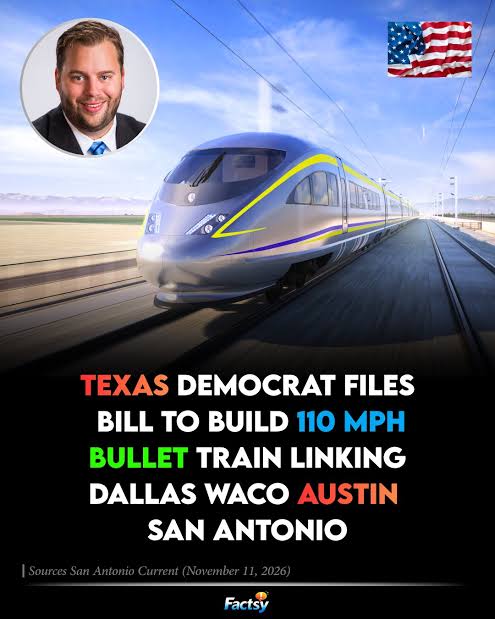


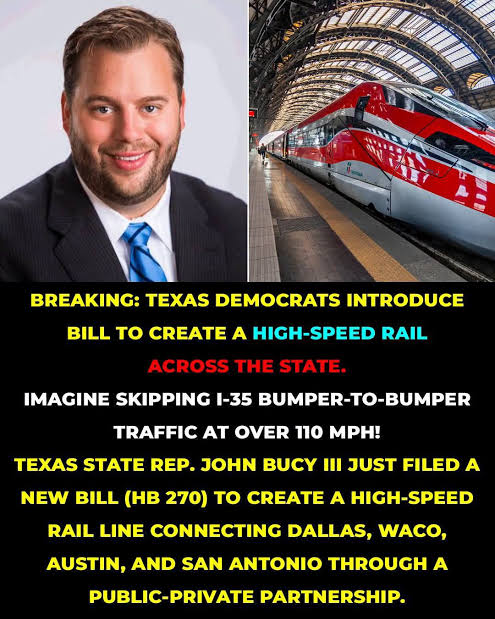
Texas House Bill 270 (HB 270), filed on November 9, 2026, by State Representative John Bucy (D-Austin), proposes a public-private partnership to develop high-speed passenger rail along the Interstate 35 corridor. Filed ahead of the 90th Texas Legislative Session—which convenes on January 12, 2027—the legislation aims to connect Dallas, Waco, Austin, and San Antonio. [1, 2, 3, 4]
Key Provisions of HB 270
- Public-Private Partnership: The bill directs the Texas Department of Transportation (TxDOT) to enter into an agreement with a private entity to construct, maintain, and operate the rail system, while the state retains regulatory oversight. [1, 2]
- Speed Requirements: HB 270 defines high-speed rail as intercity passenger service capable of reaching speeds of at least 110 miles per hour. Rep. Bucy has stated that a modern system built under this framework could potentially reach 160 to 170 mph. [1, 2]
- Repeal of State Funding Ban: According to KRLD News, the legislation repeals a section of the Texas Transportation Code that currently prohibits the use of state funds for high-speed rail operated by a private entity. [1]
Funding and Cost Estimates
- Private Investment Model: Under Rep. Bucy’s proposal, the private partner would cover the majority of construction and operating costs, recouping its investment over time through ticket revenue. Bucy has cited Brightline in Florida as a model for privately operated passenger rail. [1]
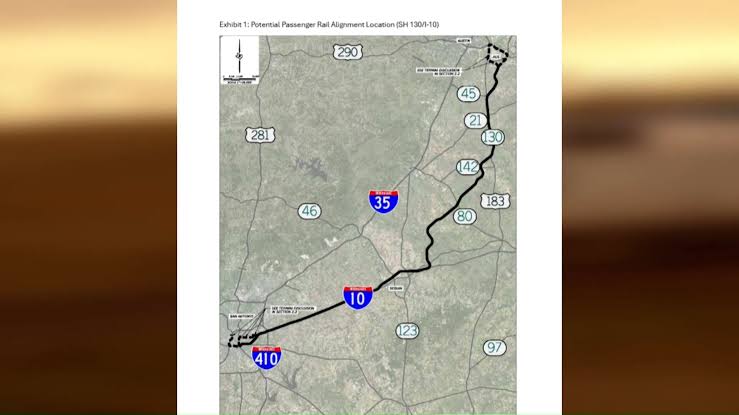
- Projected Costs: While the text of HB 270 does not include a formal cost estimate, construction timeline, or ridership projections, Rep. Bucy told KVUE that utilizing existing I-35 infrastructure and right-of-way could allow the Austin-to-San Antonio segment to be built for roughly $3 billion to $5 billion, with the rest of the corridor built out over time. For comparison, a recent Travis County-commissioned study estimated that a passenger rail line between Austin and San Antonio along I-10 and SH-130 would cost approximately $13.5 billion. [1, 2]
- Legislative Scope: Passing HB 270 would establish the legal framework for a public-private partnership, though it does not automatically approve construction or secure project funding. [1]
Broader Context and Local Momentum
- Regional Support: Local officials in Central Texas have also taken steps to advance corridor planning ahead of the 2027 session. On November 16, 2026, San Antonio District 7 Councilmember Marina Alderete Gavito filed a Council Consideration Request (CCR) urging the city to coordinate with Bexar County, Austin, and regional planning agencies to pursue state, private, and federal funding for an Austin–San Antonio line.
- Political Landscape: Proponents—including Rep. Bucy and Austin City Council Member Vanessa Fuentes—have pointed to the incoming state leadership taking office in January 2027, including Governor-elect Gina Hinojosa, as a potential shift in legislative receptiveness toward passenger rail.
- Legislative Tracking: You can view the official bill filing details on LegiScan. [1, 2, 3, 4, 5]