

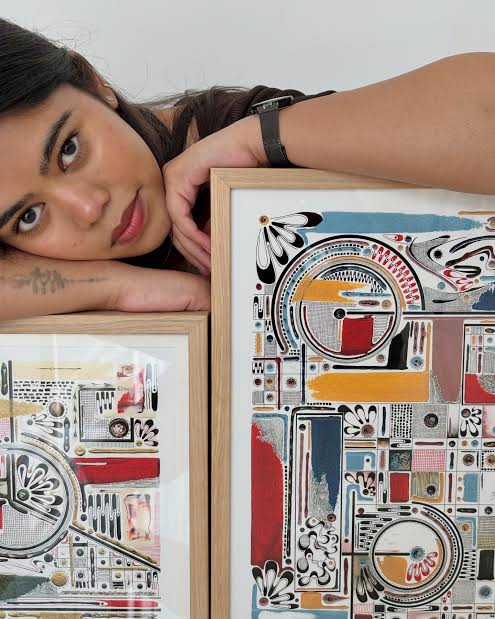
“a very unique style reminiscent of the 70s space artists but with a hint of Japanese traditional 🎨 artistry and calligraphy” – Trinity
You can find and follow Artist Anamika (the oblivious mind)
On instagram with the link below 👇
Key 1970s Space Sci-Fi Artists:
- Chris Foss: Known for incredibly large, detailed, and colorful spaceships on, paperback covers.
- Peter Elson: English illustrator known for the Terran Trade Authority series and, atmospheric, sleek, spaceship illustrations.
- John Berkey: Famous for, impressionistic, and, sweeping, depictions of space-ships and, early Star Wars art.
- Ralph McQuarrie: Key conceptual artist for Star Wars: The Empire Strikes Back, defining the look of 70s space-opera.
- Don Davis & Rick Guidice: NASA-commissioned artists who created realistic, and, influential, scenes of space, colonization and, orbital habitats in the mid-70s.
- Bob Layzell: Known for atmospheric, and, imaginative spaceship art, featured in the Terran Trade Authority books.
- Dean Ellis: Contributed to the, iconic 70s, cover art style often showcasing, detailed ships.
- Leo & Diane Dillon: Won awards for, intricate and, stylistically diverse cover art (often described as, “surrealist” and, “woodcut-styled”).
Renowned Traditional Artists (Edo Period Focus)
- Katsushika Hokusai (1760–1849): Famous for Thirty-Six Views of Mount Fuji and The Great Wave off Kanagawa, he produced over 30,000 works and heavily influenced Western Impressionism.
- Utagawa Hiroshige (1797–1858): Known for his mastery in landscape prints, specifically The Fifty-three Stations of the Tōkaidō and The Sixty-nine Stations of the Kisokaidō, characterized by, moody, atmospheric scenes of rain, snow, and moonlight.
- Kitagawa Utamaro (c. 1753–1806): Renowned for his idealized portraits of women (bijinga), specializing in upper-torso studies known as ōkubi-e.
- Tawaraya Sōtatsu (active c. 1600–1640): A founder of the Rinpa school, known for reviving classical Japanese themes with a vibrant, decorative style.
- Sesson Shūkei (c. 1504–c. 1589): A Zen monk painter who developed a highly individualistic style of ink painting.
- Shibata Zeshin (1807–1891): A master of both painting and lacquer work, known for creating delicate lacquer art that blended traditional Japanese aesthetics with painting techniques.
Key Traditional Art Movements & Mediums
- Ukiyo-e: “Pictures of the floating world,” woodblock prints focusing on, for example, kabuki actors, beautiful women, and landscapes.
- Kanō School: A, for example, long-lived school of painting, often producing large, screen paintings with strong ink strokes and, for example, gold leaf decoration.
- Lacquerware (Urushi): Techniques including maki-e (sprinkled metal powder) and chinkin (sunken gold inlay) were often used in, for example, decorative arts.
- Calligraphy (Shodō): The artistic, for example, styling of written characters.